The Basis 108, an Apple ][+ from Germany
In the early eighties Basis, a small company in West Germany, made its own Apple ][+: the Basis 108. It was built for work, in a heavy case of cast aluminium with the keyboard apart, and it had what an Apple ][+ needed cards for: 80 columns of text with small letters, a parallel and a serial port, and a second processor, a Z80, to run CP/M, beside the 6502 for the programs of the Apple. Its characters could be the ones of ASCII, the German ones, the signs of APL, or the Apple’s own.
This page switches it on, writes in small letters, changes its characters from BASIC, and starts Apple’s DOS 3.3 on it, in 80 columns.
What you need
For the last step, DOS 3.3 System Master - 680-0210-A (1982).dsk,
Apple’s DOS 3.3 System Master, on the
Asimov archive.
./fetch-disks.sh in this repository downloads it into disks/ and checks
it. The rest needs nothing but izapple2, which carries the ROMs of the
Basis 108.
The instruction manual of the Basis 108, of 1982, in German, is on Applefritter, a scan of 100 MB.
The machine
A Basis 108:
- the 6502 processor at 1 MHz and its memory, with 16 KB of a language card, which izapple2 puts in slot 0;
- the ROM of the Basis 108, with Applesoft BASIC and the Monitor, and its 80 columns built in;
- its characters, in four sets.
izapple2 has neither its Z80 nor its ports.
izapple2 -model none -board basis108 -cpu 6502 -screen green \
    -rom "<custom>" \
    -charrom "<internal>/D29_basis_cg_2532.rom.BIN" \
    -s0 language
For DOS 3.3, the same machine with a Disk II controller in slot 6 and the System Master in drive 1:
izapple2 -model none -board basis108 -cpu 6502 -screen green \
    -rom "<custom>" \
    -charrom "<internal>/D29_basis_cg_2532.rom.BIN" \
    -s0 language \
    -s6 'diskii,disk1=disks/DOS 3.3 System Master - 680-0210-A (1982).dsk'
The model basis108 of izapple2 has this second machine, with the DOS 3.3
diskette that izapple2 carries, and a Videx Videoterm 80 column card more:
izapple2 -model basis108 -screen green
Switched on
-
Start izapple2 with the first command. Where an Apple ][+ says
APPLE ][in 40 columns, the Basis 108 says its name in small letters, and in 80 columns: the screen has twice as many characters across, from the start, with no card.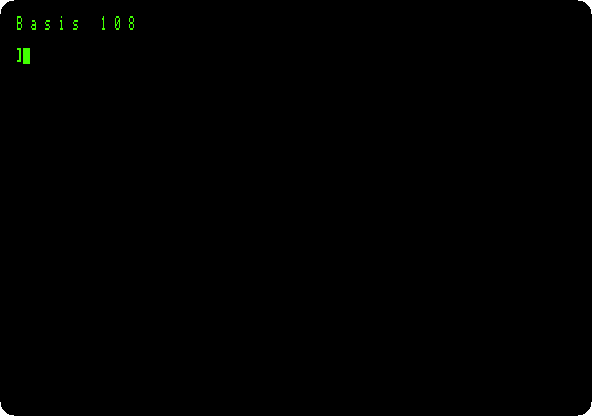
-
Type
PRINT "@ABC [\]^_ abc {|}~ 0123".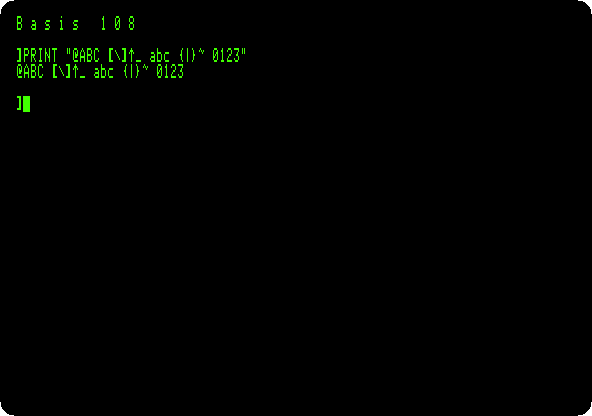
Capitals, small letters and the signs of ASCII, as a terminal of the time had them. The Apple ][+ shows no small letters, and none of
` { | } ~.
Its characters
The Basis 108 keeps four sets of characters, and soft switches of its own
choose among them: $C002 and $C003 the first bit of the set, and
$C004 and $C005 the second. A POKE to one of these addresses from
BASIC, with any value, throws the switch. The characters in memory stay as
they are; what changes is how they look.
-
Type
POKE 49155,0: POKE 49156,0,$C003and$C004: the German set.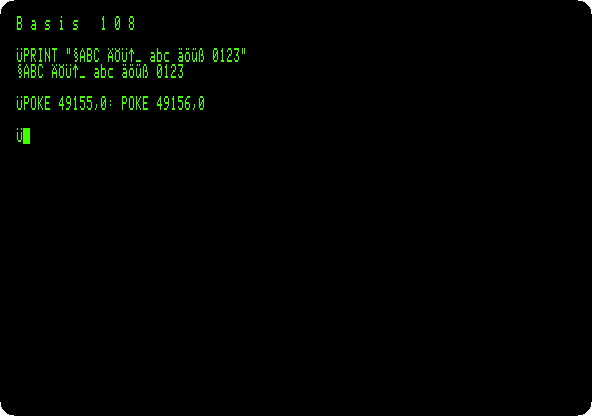
The signs that German has no use for are its letters:
@is§,[ \ ]areÄ Ö Ü, and{ | } ~areä ö ü ß. Even the prompt of Applesoft,], is anÜnow. -
Type
POKE 49157,0,$C005: the set of APL, the language of mathematicians, with a sign for each of its operations.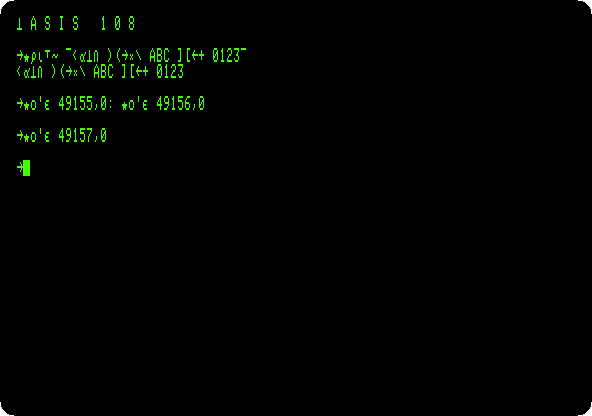
-
Type
POKE 49154,0: POKE 49156,0,$C002and$C004: the set of the Apple ][, the one for programs written for it.![The characters of the Apple ][](/guides/images/basis108/apple.png)
It has no small letters, and shows signs where they were.
POKE 49157,0brings back ASCII, the set it started with.
Apple’s DOS
-
Quit izapple2 and start it with the second command. The Basis 108 starts DOS 3.3 from the System Master, as an Apple ][+ would, but in 80 columns. Type
CATALOG.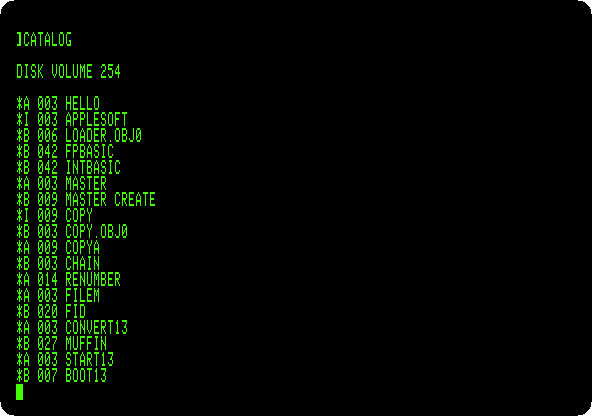
DOS writes its lines as on the Apple, and they take half the width of the screen.
What next
The Base 64A is another copy, from Taiwan, with a word processor in its ROM, and Switch on an Apple ][+ the machine both copied.