CP/M on three Z80 cards
CP/M ran on the Z80 and the Apple II had a 6502, so to run CP/M an Apple II owner bought a Z80 on a card. Microsoft made the first, the Z80 SoftCard, in 1980. Its Z80 takes the machine over while the 6502 waits, and uses the Apple’s own memory, so the CP/M it runs has what the Apple has left. Others followed, and some worked the other way round. On the PCPI Applicard and on Microsoft’s own SoftCard II of 1984, the Z80 has 64 KB of memory of its own and runs CP/M there. The 6502 stays in charge of the screen, the keyboard and the disks, and the two pass bytes to each other through a port.
Each card came with its own CP/M, and the SoftCard went through several versions, from Microsoft and from others. This page starts every version found for the three cards izapple2 has, one after the other, and compares them: what each says when it starts, what came on its disk, how much memory it leaves to the programs, and how much the same Microsoft BASIC finds free.
What you need
The disks are in the CP/M folder of the Asimov
archive,
and ./fetch-disks.sh in this repository downloads them all into disks/
and checks them. In that folder:
Softcard 16-sector disk (Microsoft 1980).dsk: CP/M 2.20 of the SoftCard, for 44 KB.CPM1.PO, insoftcard.zip: CP/M 2.20B of the SoftCard, for 56 KB.CPM60K.DSK: CP/M 2.23 of the SoftCard, for 60 KB.CPM2.23(60k).dsk: a CP/M 2.23B of 63 KB, marked as Datasoft’s.CPM3.1_Disk_1.dsk, inCPM3.1_Z80_Softcard.zip: CP/M 3.0 for the SoftCard.CPAM40B.dsk,A.E. CPM Plus card.dskandCPAM51A.dsk: CP/AM 4.0B, 5.1 and 5.1.1, the CP/M of Applied Engineering.Microsoft Softcard II CPM 2.28B.DSK: CP/M 2.28B of the SoftCard II.pcpiboot.do, in thepcpifolder: CP/M 2.2 of the Applicard, the boot disk of PCPI.
The manuals are on the Internet Archive: the SoftCard CP/M Reference Manual of Microsoft, the SoftCard II Installation and Operations Manual and Programmer’s Manual, and the Appli-Card 2.0 Installation and User’s Manual of PCPI.
The machines
Two machines, each with two disk drives on a Disk II controller card in slot 6 and a Z80 card in slot 4, the card of the CP/M started:
- an Apple ][+, its 6502 at 1 MHz, 48 KB of memory, Applesoft BASIC in its ROM and the keyboard that types only capitals, with a 16 KB Language Card in slot 0, which makes the memory 64 KB;
- an Apple //e, its 6502 at 1 MHz, 128 KB of memory with its extended 80 column card.
The cards are the Microsoft Z80 SoftCard, the Microsoft SoftCard II and the PCPI Applicard. The last steps add a Videx card to the ][+, and a RamWorks to the //e.
Each version starts with its disk in drive 1, and has the disk of CP/M 2.23,
CPM60K.DSK, in drive 2, for the DDT on it; the command of each is in its
step. The SoftCard II and the Applicard need izapple2 2.6.0 or later, the
first release with them.
The SoftCard
-
Start CP/M 2.20 on the ][+, the CP/M of the SoftCard of 1980:
izapple2 -model none -board 2plus -cpu 6502 -screen green \
    -rom "<internal>/Apple2_Plus.rom" \
    -charrom "<internal>/Apple2rev7CharGen.rom" -forceCaps \
    -s0 language \
    -s4 z80softcard \
    -s6 'diskii,disk1=disks/Softcard 16-sector disk (Microsoft 1980).dsk,disk2=disks/CPM60K.DSK'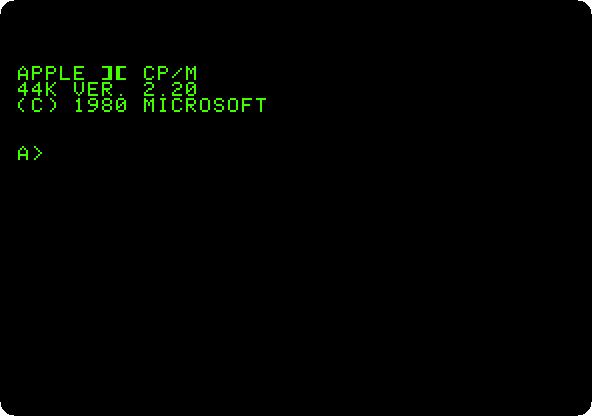
44K: the Z80 shares the 48 KB of the ][+. The Apple keeps the bottom of its memory, the text screen among it, and the SoftCard moves the Z80’s addresses so that CP/M still finds its memory where it wants it. This version is for a ][+ without the Language Card, and starts on one with it too.
-
Start CP/M 2.20B, the version that came after, for 56 KB:
izapple2 -model none -board 2plus -cpu 6502 -screen green \
    -rom "<internal>/Apple2_Plus.rom" \
    -charrom "<internal>/Apple2rev7CharGen.rom" -forceCaps \
    -s0 language \
    -s4 z80softcard \
    -s6 'diskii,disk1=disks/CPM1.PO,disk2=disks/CPM60K.DSK'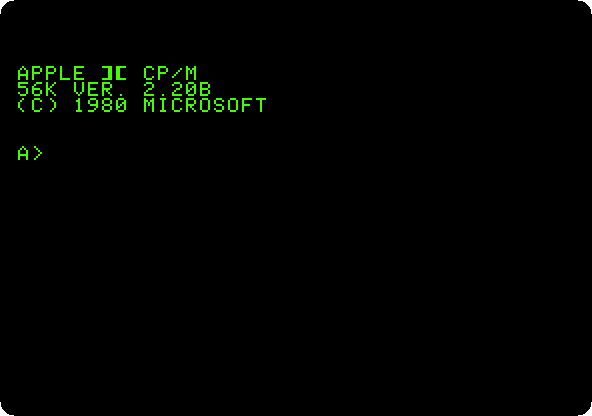
56K, for a ][+ with the Language Card. CP/M on the Z80 SoftCard uses this disk. In izapple2, 2.20 and 2.20B stop on the //e after the drive, so the page starts them on the ][+, the machine of their time.
-
Start CP/M 2.23 on the //e, Microsoft’s version of 1982, for 60 KB:
izapple2 -model none -board 2e -cpu 6502 -screen green \
    -rom "<internal>/Apple2e.rom" \
    -charrom "<internal>/Apple IIe Video Unenhanced.bin" \
    -s0 language \
    -s4 z80softcard \
    -s6 'diskii,disk1=disks/CPM60K.DSK,disk2=disks/CPM60K.DSK'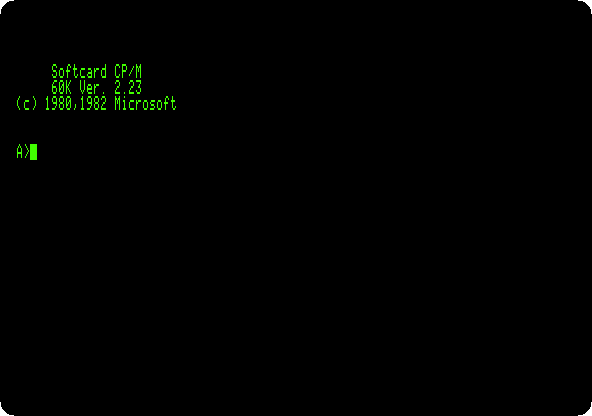
It knows the //e: 80 columns and lower case, with the 80 column card of the //e. Type
DIRfor the files of its disk: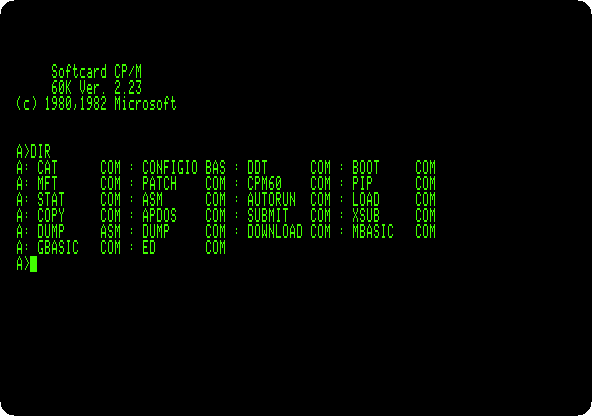
The tools of Digital Research,
PIP,ED,ASM,DDT,STAT,SUBMIT, with Microsoft’s BASIC-80,MBASICandGBASIC, and the programs of the SoftCard,CONFIGIO.BAS,APDOS,COPY,CPM60and others. -
Start the CP/M 2.23B of Datasoft, back on the ][+, which says it has 63 KB:
izapple2 -model none -board 2plus -cpu 6502 -screen green \
    -rom "<internal>/Apple2_Plus.rom" \
    -charrom "<internal>/Apple2rev7CharGen.rom" -forceCaps \
    -s0 language \
    -s4 z80softcard \
    -s6 'diskii,disk1=disks/CPM2.23(60k).dsk,disk2=disks/CPM60K.DSK'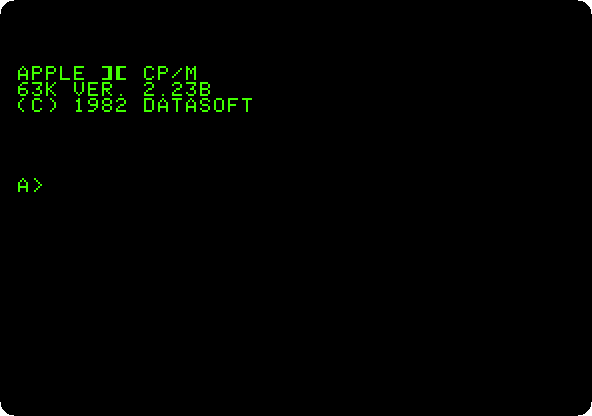
Like 2.20 and 2.20B, it stops on the //e after the drive. Its 63K is only in what it says: below, its CP/M sits in memory where the 56K of 2.20B does, and its GBASIC is the one of 2.20B. Its disk has no program to make a bigger system, as
CPM60is on the disk of 2.23. -
Start CP/M 3.0, a port of Digital Research’s CP/M Plus to the SoftCard, by Werner Muenchheimer in Germany in 1989:
izapple2 -model none -board 2e -cpu 6502 -screen green \
    -rom "<internal>/Apple2e.rom" \
    -charrom "<internal>/Apple IIe Video Unenhanced.bin" \
    -s0 language \
    -s4 z80softcard \
    -s6 'diskii,disk1=disks/CPM3.1_Disk_1.dsk,disk2=disks/CPM60K.DSK'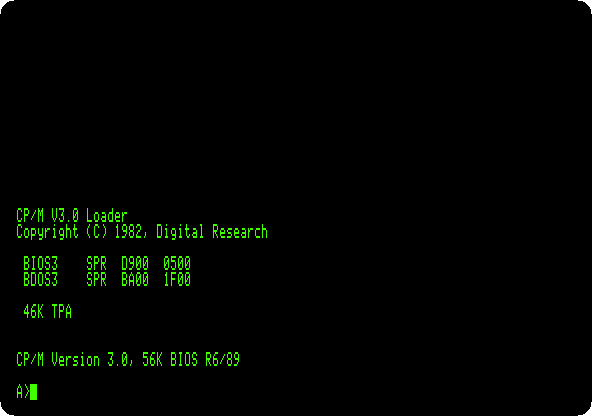
Its loader lists the parts of the system it loads, the BIOS and the BDOS, and where, and leaves 46K TPA, the memory for the programs. Type
DIR: some of the programs of CP/M 3 are new,DATE,SET,SETDEFandSHOWamong them.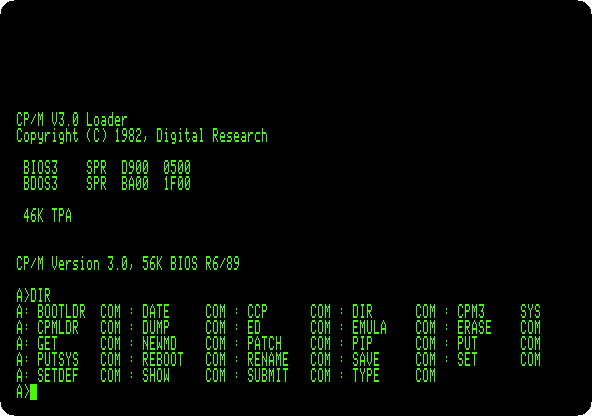
-
Start CP/AM 4.0B, the CP/M of Applied Engineering, of 1985:
izapple2 -model none -board 2e -cpu 6502 -screen green \
    -rom "<internal>/Apple2e.rom" \
    -charrom "<internal>/Apple IIe Video Unenhanced.bin" \
    -s0 language \
    -s4 z80softcard \
    -s6 'diskii,disk1=disks/CPAM40B.dsk,disk2=disks/CPM60K.DSK'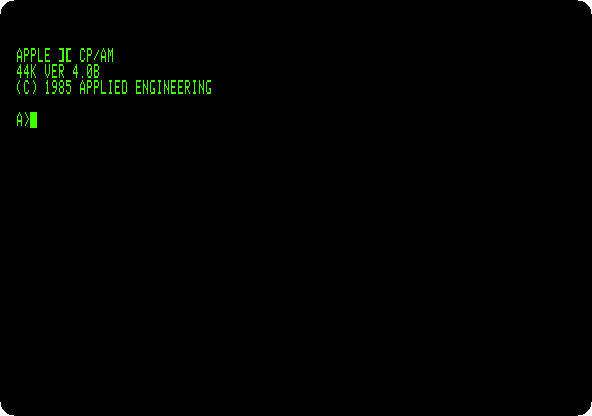
CP/AM was made for the Z-80 Plus, the Z80 card Applied Engineering sold, a copy of the SoftCard that works as it does. izapple2 has no Z-80 Plus, and doesn’t need it: CP/AM starts on its SoftCard. On the Applicard and the SoftCard II it says NO A.E. Z-80 PLUS CARD FOUND.
-
Start CP/AM 5.1 and CP/AM 5.1.1, of 1986, for 60 KB:
izapple2 -model none -board 2e -cpu 6502 -screen green \
    -rom "<internal>/Apple2e.rom" \
    -charrom "<internal>/Apple IIe Video Unenhanced.bin" \
    -s0 language \
    -s4 z80softcard \
    -s6 'diskii,disk1=disks/A.E. CPM Plus card.dsk,disk2=disks/CPM60K.DSK'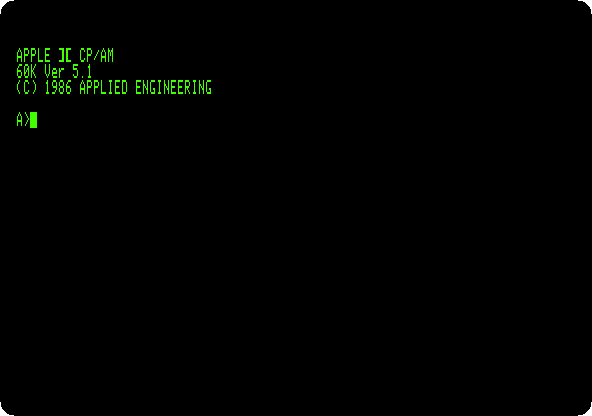
izapple2 -model none -board 2e -cpu 6502 -screen green \
    -rom "<internal>/Apple2e.rom" \
    -charrom "<internal>/Apple IIe Video Unenhanced.bin" \
    -s0 language \
    -s4 z80softcard \
    -s6 'diskii,disk1=disks/CPAM51A.dsk,disk2=disks/CPM60K.DSK'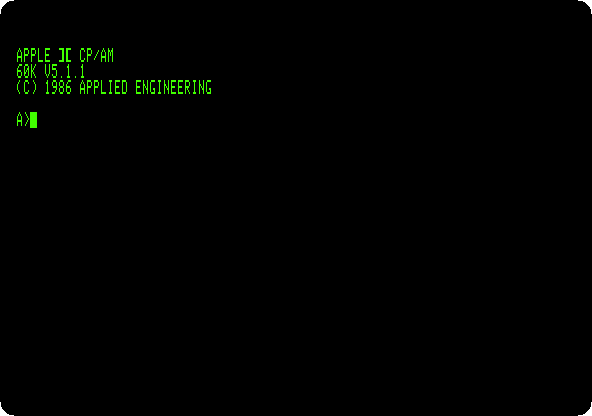
Type
DIRon 5.1.1. Beside the programs of CP/M are Applied Engineering’s own,RAMBOOT,MEGDRIVE,CPAM60FandCPAM60Samong them, which use the memory of a //e beyond its 64 KB, below. A file named-10/7/87 R21looks like the label of someone’s own copy, not a master.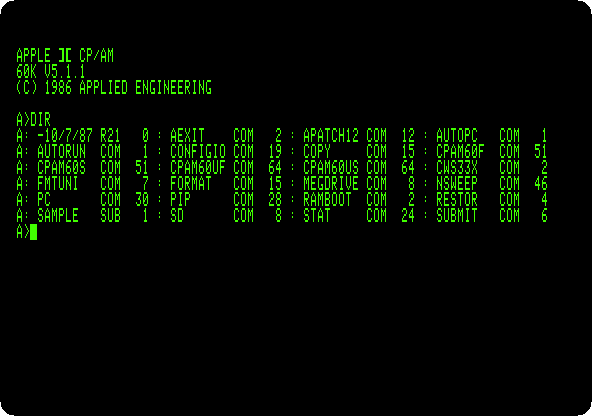
The SoftCard II
-
Start CP/M 2.28B on the //e with the SoftCard II:
izapple2 -model none -board 2e -cpu 6502 -screen green \
    -rom "<internal>/Apple2e.rom" \
    -charrom "<internal>/Apple IIe Video Unenhanced.bin" \
    -s0 language \
    -s4 z80softcard2 \
    -s6 'diskii,disk1=disks/Microsoft Softcard II CPM 2.28B.DSK,disk2=disks/CPM60K.DSK'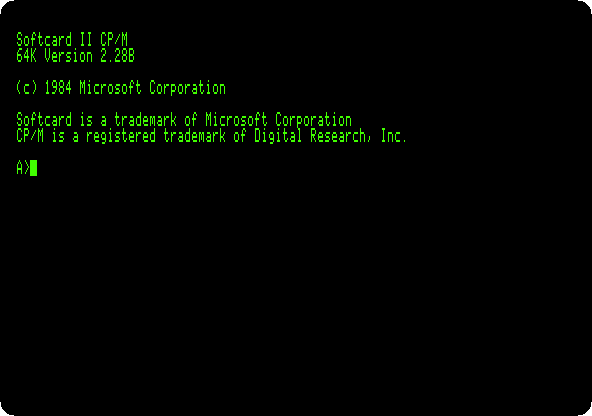
64K: all of the Z80’s memory is its own, none of it the Apple’s. Type
DIR: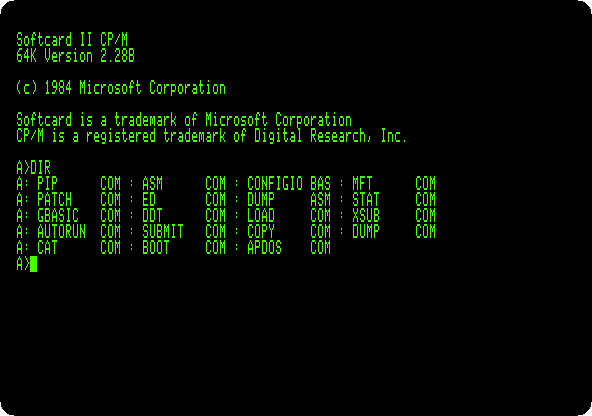
The programs of the SoftCard’s 2.23, but for
MBASIC,CPM60andDOWNLOAD: of the two BASICs, Microsoft kept GBASIC, the one with the graphics. On the ][+ this CP/M prints its words in lower case, which the ][+ shows as other signs; with a Videx card it shows them in 80 columns, below.
The Applicard
-
Start CP/M 2.2 on the //e with the Applicard:
izapple2 -model none -board 2e -cpu 6502 -screen green \
    -rom "<internal>/Apple2e.rom" \
    -charrom "<internal>/Apple IIe Video Unenhanced.bin" \
    -s0 language \
    -s4 applicard \
    -s6 'diskii,disk1=disks/pcpiboot.do,disk2=disks/CPM60K.DSK'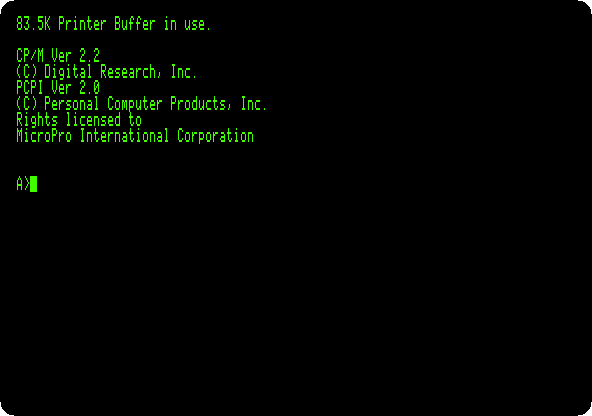
This is the CP/M of Digital Research as it came, version 2.2, with PCPI’s part, version 2.0, under it. Licensed to MicroPro, the makers of WordStar. The Z80 has its own memory, so the Apple’s is free, and PCPI uses it as a buffer for the printer: 83.5K on the //e.
Type
DIR: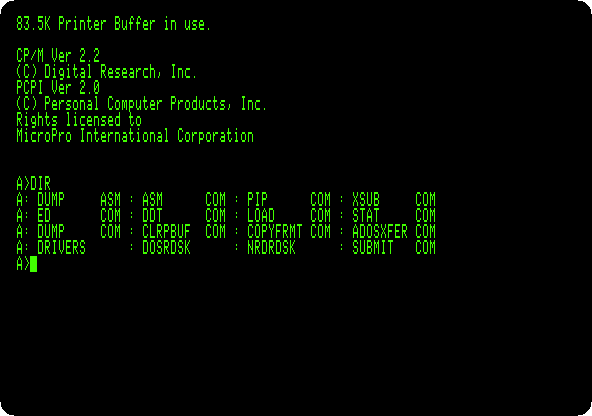
The tools of Digital Research again, and PCPI’s own,
DRIVERS,ADOSXFER,COPYFRMT,CLRPBUF,DOSRDSKandNRDRDSK. No BASIC. -
Start it on the ][+, with the Applicard in slot 4:
izapple2 -model none -board 2plus -cpu 6502 -screen green \ -rom "<internal>/Apple2_Plus.rom" \ -charrom "<internal>/Apple2rev7CharGen.rom" -forceCaps \ -s0 language \ -s4 applicard \ -s6 'diskii,disk1=disks/pcpiboot.do,disk2=disks/CPM60K.DSK'![CP/M 2.2 of the Applicard on the ][+](/guides/images/cpm-cards/applicard-2.0-plus.png)
The same CP/M, in capitals and 40 columns, and a buffer of 35.5K: the ][+ has 64 KB with its Language Card, the //e has 128 KB with its 80 column card.
The same BASIC on each
GBASIC, Microsoft’s BASIC-80 with the graphics of the Apple II, is on the disks of the SoftCard and of the SoftCard II. The number it says when it starts, the memory free for a program, compares the versions.
-
Type
GBASICon CP/M 2.20, 2.23 and 2.28B: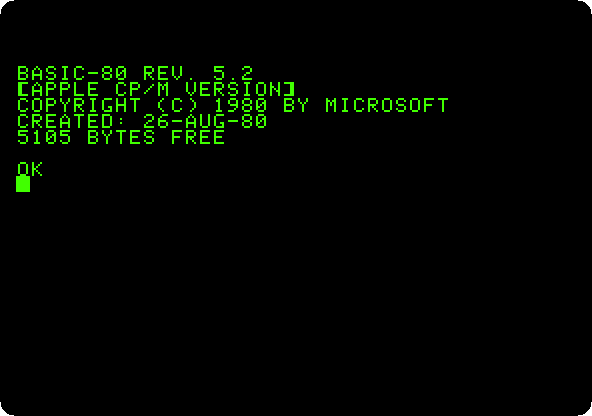
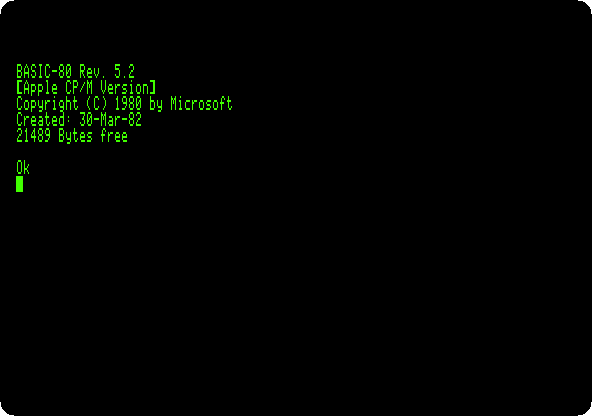
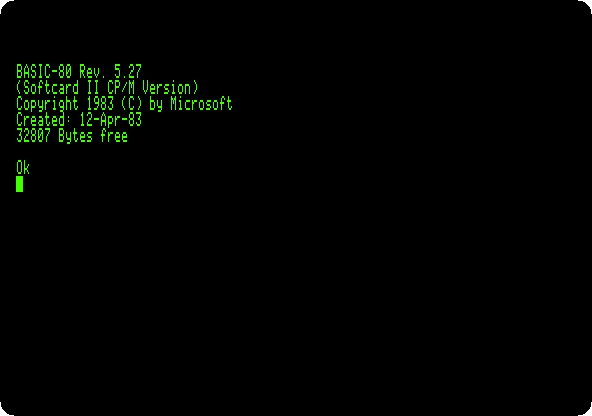
On 2.20B and on Datasoft’s 2.23B it says 17393 BYTES FREE; both have the GBASIC of November 1980. The Applicard, CP/AM and CP/M 3 have no GBASIC. Type
SYSTEMto go back to CP/M.
The memory for the programs
The programs of CP/M run from address 0100, hexadecimal, up to where the BDOS starts, the part of CP/M they call for the disk and the screen: that memory is the TPA, the Transient Program Area. A program finds the BDOS by the jump at address 5, and the address of that jump, at 6 and 7, is the top of its memory. Above the BDOS is the BIOS, the part written for the machine, and the jump at address 0 goes into it, to start CP/M again. DDT, the debugger of CP/M, could show both, but under DDT the jump at 5 goes to DDT, which moves itself just under the BDOS. So a program of five instructions, assembled in DDT, copies the two addresses away, and runs without DDT.
-
Start DDT from drive 2, type its
Acommand and the program, an empty line to end it, andG0to leave DDT:B:DDT A100 LHLD 6 SHLD 3000 LHLD 1 SHLD 3002 JMP 0 G0LHLD 6loads the address at 6 and 7,SHLD 3000stores it at 3000, the next two do the same with the address at 1 and 2, andJMP 0goes back to CP/M. TypeSAVE 1 TPA.COM, which saves one page, 256 bytes from 0100, as the programTPA, typeTPAto run it, then typeB:DDTagain andD3000,3003to show what it stored. Here on the SoftCard II: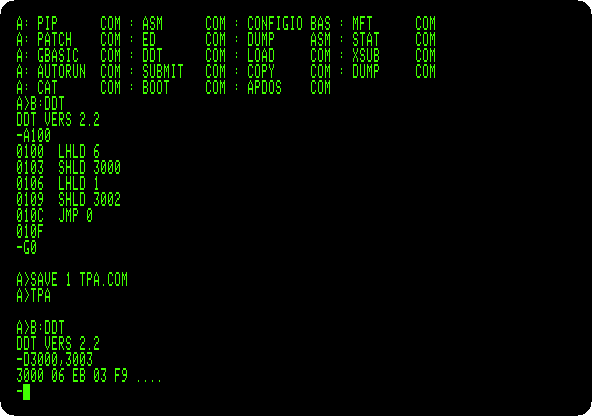
06 EB, low byte first: the jump goes to EB06, the BDOS starts at EB00, and the TPA is from 0100 to EAFF, 59,904 bytes. 03 F9: the BIOS starts at F900. Type
G0to go back to CP/M.The
SAVEof CP/M 3 works the other way round: typeSAVEbeforeB:DDT, and when DDT ends, it asks for the name of the file,TPA.COM, and the addresses to save, from100to10E.
The same program on each version, in the order of the page:
| Card | CP/M | Of | It says | BDOS at | BIOS at | TPA | As a CP/M 2.2 of | GBASIC leaves |
|---|---|---|---|---|---|---|---|---|
| SoftCard | 2.20 | Microsoft, 1980 | 44K | 9C00 | AA00 | 39,680 bytes | 44K | 5,105 bytes |
| SoftCard | 2.20B | Microsoft, 1980 | 56K | CC00 | DA00 | 51,968 bytes | 56K | 17,393 bytes |
| SoftCard | 2.23 | Microsoft, 1982 | 60K | DC00 | FA00 | 56,064 bytes | 60K | 21,489 bytes |
| SoftCard | 2.23B | Datasoft, 1982 | 63K | CC00 | DA00 | 51,968 bytes | 56K | 17,393 bytes |
| SoftCard | 3.0 | Werner Muenchheimer, 1989 | 46K TPA | BA00 | D900 | 47,360 bytes | ||
| SoftCard | CP/AM 4.0B | Applied Engineering, 1985 | 44K | 9C00 | AA00 | 39,680 bytes | 44K | |
| SoftCard | CP/AM 5.1 and 5.1.1 | Applied Engineering, 1986 | 60K | CD00 | DB00 | 52,224 bytes | 56.25K | |
| SoftCard II | 2.28B | Microsoft, 1984 | 64K | EB00 | F900 | 59,904 bytes | 63.75K | 32,807 bytes |
| Applicard | 2.2, PCPI 2.0 | Digital Research and PCPI | E500 | F300 | 58,368 bytes | 62.25K |
The years and the sizes the systems say are those they show when they start. The size a CP/M 2.2 says is the memory it was made for: Digital Research’s CP/M 2.2 Alteration Guide puts the BDOS of a CP/M of 20K at 3C00 and its BIOS at 4A00, and those of a bigger one as many kilobytes higher as it has more. By that rule the BDOS of each is that of the size in the next to last column. Microsoft’s 44K, 56K and 60K are what they say; 2.23 keeps its BIOS higher than the rule, at FA00, as its 60K would put it at EA00. Datasoft’s “63K” is Microsoft’s 56K, with its BDOS and BIOS where they are in 2.20B, and leaves exactly what it does. CP/AM’s 60K is a 56K and a quarter, and leaves 3.75 KB less than Microsoft’s 60K. The SoftCard II leaves the most, its Z80 having its 64 KB to itself; the Applicard 1.5 KB less, with the same 64 KB. CP/M 3 is built another way, and says its TPA itself, 46K, and it is: 46.25 KB.
Each version leaves the same memory on each machine it starts on, below: the ][+ or the //e, with an 80 column card or without.
On the SoftCard II, GBASIC’s HPLOT doesn’t end in izapple2 yet, so the
page doesn’t draw with it; see CP/M on the Z80 SoftCard for a
drawing on the SoftCard.
On the ][+ and on the //e
Each version, started on six machines: the ][+ alone, with 48 KB; with the
Language Card in slot 0; with a Videx Videoterm in slot 3 as well, the 80
column card of the ][+; the //e of the page; the same //e with a Videx
Videoterm in slot 3; and the enhanced //e, with its 65C02. The commands are
those of the steps above, with -s0 language taken out, or -s3 videx
added, or for the enhanced //e -cpu 65c02, the ROM
<internal>/Apple2e_Enhanced.rom and the characters
<internal>/Apple IIe Video Enhanced.bin. It starts in 40 columns, in the 80
of the //e, in the 80 of the Videx, or doesn’t start:
| CP/M | ][+ | ][+, Language Card | ][+, Language Card, Videx | //e | //e, Videx | Enhanced //e |
|---|---|---|---|---|---|---|
| 2.20 | 40 | 40 | no | no | no | no |
| 2.20B | no | 40 | no | no | no | no |
| 2.23 | no | 40 | Videx | 80 | 80 | 80 |
| 2.23B of Datasoft | no | 40 | no | no | no | no |
| 3.0 | no | no | Videx | 80 | 80 | 80 |
| CP/AM 4.0B | 40 | 40 | Videx | 80 | 80 | 80 |
| CP/AM 5.1 and 5.1.1 | no | no | Videx | 80 | 80 | 80 |
| 2.28B of the SoftCard II | no | 40, lower case as other signs | Videx | 80 | Videx | 80 |
| 2.2 of the Applicard | 40 | 40 | Videx | 80 | 80 | 80 |
- The Language Card: on the SoftCard, the Z80 has the Apple’s memory, so the versions of 56K and more need the 16 KB of the Language Card, and those of 44K start without it. The SoftCard II needs it as well, though its Z80 has its own memory: without it the screen stays empty. The Applicard starts without it, and its buffer for the printer, in the Apple’s memory, grows with it: 19.5K on the ][+ of 48 KB, 35.5K with the Language Card.
- 80 columns: on the //e, every version that starts uses the 80 columns of the //e, and only the SoftCard II goes to a Videx card when there is one. On the ][+ the Videx is used by every version that starts with it, and CP/M 3, CP/AM 5.1 and 5.1.1 and the SoftCard II need it: without it, CP/M 3 runs the 6502 into an instruction it doesn’t have, which stops izapple2, CP/AM 5.1 stays at the APPLE ][ of the start, 5.1.1 at an empty screen, and the SoftCard II prints its lower case. 2.20, 2.20B and Datasoft’s 2.23B are of 40 columns only, and in izapple2 they stay at the APPLE ][ of the start when there is a Videx card in slot 3. Every other version has 80 columns, on a //e or with a Videx card. The enhanced //e changes nothing.
- The memory of the //e beyond 64 KB: the Applicard uses it for its buffer for the printer, which grows to 83.5K, and CP/AM makes a disk of it, below. A RamWorks of 1 MB in its place doesn’t make the Applicard’s buffer bigger.
-
Start CP/M 3.0 on the ][+, with the Language Card and the Videx card:
izapple2 -model none -board 2plus -cpu 6502 -screen green \ -rom "<internal>/Apple2_Plus.rom" \ -charrom "<internal>/Apple2rev7CharGen.rom" -forceCaps \ -s0 language \ -s3 videx \ -s4 z80softcard \ -s6 'diskii,disk1=disks/CPM3.1_Disk_1.dsk,disk2=disks/CPM60K.DSK'![CP/M 3.0 on the ][+ with a Videx card](/guides/images/cpm-cards/softcard-3.0-videx.png)
The same CP/M 3, its BIOS and BDOS where they are on the //e, in the letters of the Videx.
-
Start CP/AM 5.1.1 on a //e with a RamWorks, Applied Engineering’s card of memory for the auxiliary slot, here of 1 MB, which also gives the 80 columns:
izapple2 -model none -board 2e -cpu 6502 -screen green \
    -rom "<internal>/Apple2e.rom" \
    -charrom "<internal>/Apple IIe Video Unenhanced.bin" \
    -ramworks 1024 \
    -s0 language \
    -s4 z80softcard \
    -s6 'diskii,disk1=disks/CPAM51A.dsk,disk2=disks/CPM60K.DSK'
Type
MEGDRIVE, which makes a disk C: of the memory of the card,PIP C:=A:STAT.COMto copy a file to it,C:,DIRandSTAT C::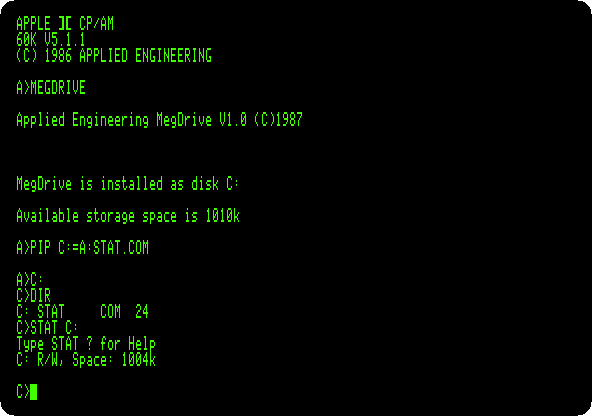
A disk of 1010K, gone when the machine is turned off. On the //e without the RamWorks, MEGDRIVE makes it of 54K. CP/AM 4.0B and 5.1 have
RAMDRIVEinstead, which does the same: RAMDRIVE is emulating C: with 64K available on the //e, and with 1024K available with the RamWorks.
Other disks found
These were found too, and are not on the page:
- 44 KB versions of 2.20B, the Original Master of the RIAG
collection,
and of 2.23,
CPMV233.DSKon Asimov: the same versions, for a ][+ without a Language Card. - The Applicard’s disk as sold with the StarCard,
Starcard - CPM Version 2.2 CP2-681-10107.DSKon Asimov: the same CP/M 2.2 and PCPI 2.0. - The Premium SoftCard IIe of Microsoft, a Z80 for the auxiliary slot of the //e, with CP/M 2.25 and 2.26: izapple2 doesn’t have this card.
- The CP/M card of ALS, Advanced Logic Systems: izapple2 doesn’t have this card either.
- XEBEC APPLE CP/M V2.20B, on the Internet
Archive, for the
SoftCard: in izapple2 it finds the card and then fills the screen with
@.
What next
Next: CP/M-65: CP/M on the 6502, CP/M written again for the 6502 itself.
CP/M on the Z80 SoftCard does more with CP/M 2.20B: an assembler source, a program in BASIC-80 saved as a file, and a drawing in GBASIC. Turbo Pascal on CP/M programs on the SoftCard.